Posts filed under ‘Uncategorized’
Must…Stay…Organized.
I am pretty sure there are a hundred million recipes out there. Actually, that number probably isn’t big enough if you count all the treasures stored in grandma’s crusty recipe box, not to mention the ones in her memory. To say the least, there are a lot. And to top it off, there are a lot of them I want to try. I see them everywhere; in magazines, at grocery stories, in cookbooks, online, emailed from a friend, sometimes even on TV. And while the idea of a recipe binder with all the ingredients and instructions printed out on cards, neatly arranged by categories sounds nice, I’ve found it is impossible and impractical for my lifestyle.
So, enter the online organizer. I am sure there are a ton of options out there – I’d love to hear what you use – but I have found Springpad to be an effective one for me. You can actually use the program to organize all sorts of other things, but thus far I’ve stuck to recipes and restaurants. The great thing about this site is you can enter URLs from recipes you find online and it will pull the ingredients and directions into a nice bookmark. Manual entry is also an option. You can mark whether it is a recipe you want to cook or something you’ve tried already, and add a 1-5 star rating as well. There is a drop-down menu of “courses” if you find that organization method useful and you can also mark your recipes with helpful tags. I’ve found ones based on the ingredients (beets, arugula, couscous) or the style of cooking (vegetarian, gluten free, soup) to be most useful.
Regardless of what program you use, my advice is to start NOW. The more links that pile up in your email or pieces of paper that accumulate on your desk (admittedly, I have some waiting for me there right now), the more time consuming – and frustrating – it will be. Spend some time when you first start and get as many recipes entered as you can. Once you’ve done that, maintaining your online cookbook is easy – if you are committed to entering new ones regularly. And believe me, it’s worth it, because when the time comes to harvest my winter squash, I’ve already got fifteen tasty recipes ready and waiting.
You’re so pitty, oh so pitty
Last night my husband and I tag teamed, and we pitted, vacuum sealed and froze approximately fifteen pounds of cherries.
And how exactly did we come about fifteen pounds of cherries (actually eighteen, but we have to eat some fresh, of course)? Well, the same way I come about many large quantities of food things – through a friend who has a connection to a farmer. In the past we’ve purchased chickens, potatoes and pork this way. It is a lot of fun, kind of like anticipating a long awaited package in the mail. These cherries came through a friend of a friend we know at the Minnesota Food Association. A farmer connection they have in Washington had pesticide free cherries ready to pick and they needed a large enough order to make the shipment to Minnesota worthwhile.
That said, this post might raise some questions for readers who know me. Why is she buying cherries from Washington, doesn’t she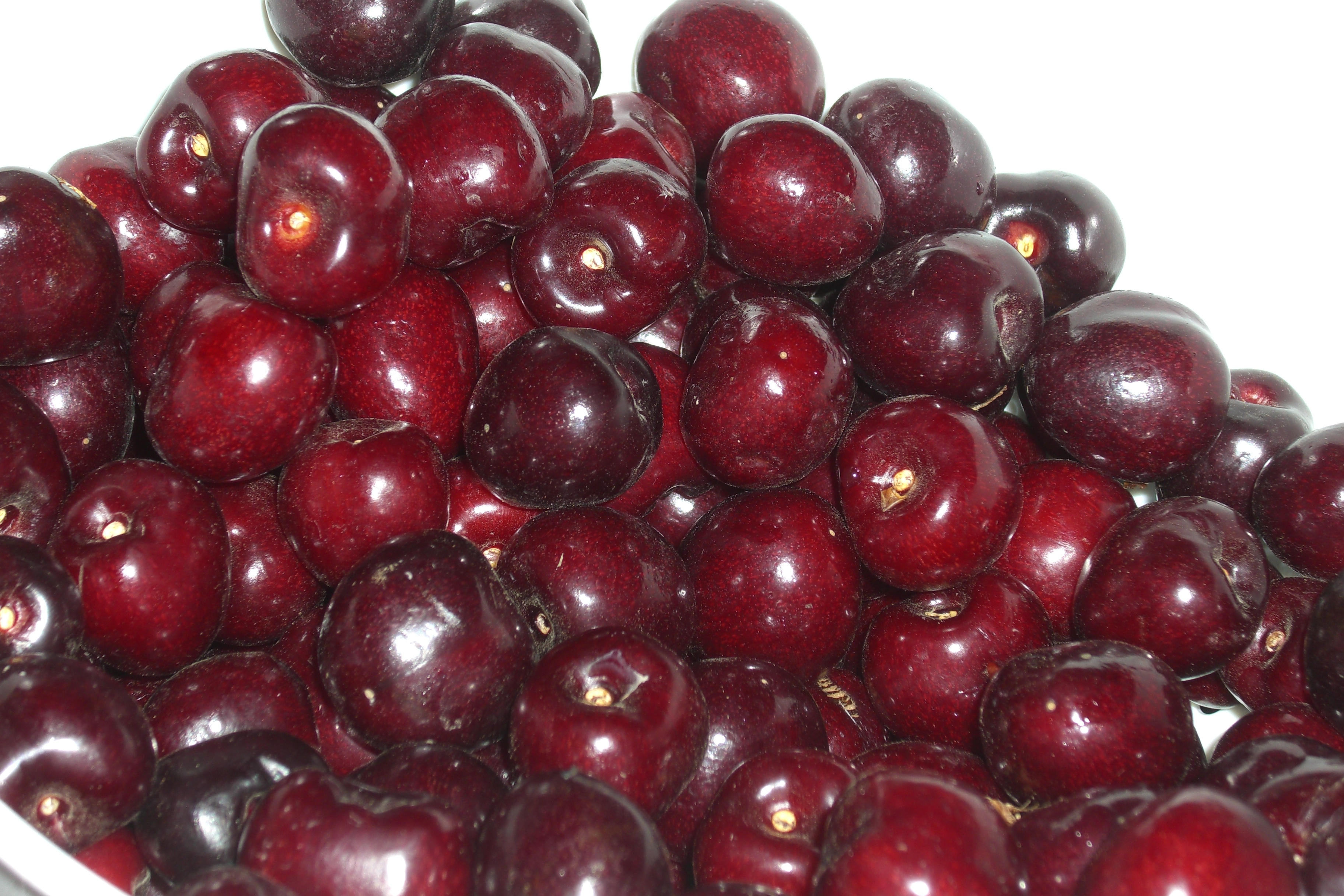 know they grow in the Midwest?
So, to “local” or “not to local”? That is a very good question. First, I am not a food purist. I do not believe it is realistic to expect that everyone will eat a nice, local, fresh, largely plant-based, organic, small farmer produced diet. At least not anytime in the foreseeable future. But I do believe that we all need to be thinking about our food, and no matter how small, we need to start making changes. Where your food is grown is only one aspect of a very complicated food system. I do believe a regionally and seasonally appropriate diet is something we should strive for, but I also enjoy a glass of orange juice many mornings throughout the year. It is not local to Minnesota and several months of the year it isn’t seasonal in Florida either. But again, if there is one thing you should learn from this blog, perfection or any notion of it, should be your last goal with food. Education should be first.
Knowing the cherries were coming from a small producer who did not spray – something I’ve found difficult to find in the cherry world – we decided this option fit our criteria for a “yes” in the food sourcing department. And at less than half the price of certified organic cherries at Whole Foods, it also fit a bit better in the budget. Not that I think I shouldn’t pay a fair price for food – it is one of the largest expenditures in our house – but there is paying a fair price and there is paying for the luxury of shopping at certain stores. But I’ll stop there, the cost of food is a whole other can of worms I’ll discuss another day.

Vacuum sealing the cherries
So, back to the cherries. Cherry preserving is a pretty easy and straightforward process. Depending on the tools in your kitchen, you have a few options. The first step no matter what is to wash and pit. My mom gifted us with a hand held cherry pitter a few Christmases ago and the whole endeavor is made much simpler. I highly recommend making this purchase should you have any desire to be a serious cherry processor.
From my experience, the next step can go one of two ways. If you own a vacuum sealer, just filled the bags, vacuum, seal and freeze. Done. If you don’t, the best method is to put your cherries in a single layer on a cookie sheet. Then put the tray in the freezer and let the cherries, you guessed it, freeze. Once the cherries are solid, put them in plastic zipper bags or whatever containers you prefer. This pre-freeze method prevents the cherries from squishing and melding into a giant blob of red which is almost impossible to navigate come eating time.
Frozen cherries in our house are used for milkshakes, fruit drinks and in morning yogurt throughout the coming months. While they’re not Minnesota Grown, we can eat them knowing they were harvested, in season, from a place that is much closer to home than the alternative – cherries sold at Christmas time in the US may be coming all the way from Australia. So, if you’re in the US and you love cherries, now is the time to find them. If you only want to eat in season, then gorge yourself. Should you want to enjoy the harvest a little longer, try your hand at some preserving. Either way, enjoy!
Eating animals
It’s a topic that many people don’t discuss in depth, though animals make up a good portion of our plates every day. Bacon for breakfast, turkey slices on a sandwich for lunch and a T-bone steak for dinner.
But what does it mean to eat animals? For some, nothing. For others, everything. For others of us, it’s somewhere in between. Since it’s bound to come up eventually, I’ll spend a little time now discussing my thoughts on eating animals. To be sure, this will not be exhaustive.
Growing up in Montana, my family was a hunting family. To be fair, I never went hunting myself, but we rarely ate “red meat” that didn’t come from an elk or deer. The few times my mom bought beef as a “special treat,” I remember noticing the fat sticking to the roof of my mouth and thinking it odd. But other than believing certain meat – or the way it was prepared – tasted good or bad, I was not discriminatory about the kinds of meat I ate until college.
Then came philosophy my junior year.
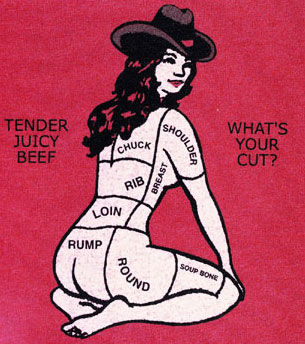
The topic was “Women and Philosophy” and the class examined how women have been viewed through the eyes of philosophy throughout history. Not exactly the place you would think you’d have a life changing experience in relation to meat. But alas, we read Carol Adam’s Neither Man nor Beast, watched a film featuring Peter Singer and discussed at length the relationship between the mistreatment of women and the mistreatment of animals and our planet. To this day, the most vivid image I have in my memory is a picture of a woman sitting on her haunches, with lines drawn on her body like cuts of meat.
So, as someone who grew up learning about the conservation of natural resources, it didn’t take long after I learned in class how much water a diet high in animals takes in comparison to one high in plants to get me thinking about what I should be eating. After further research, I made the decision in November 2004 to eliminate cows from my diet. Given that I didn’t eat much beef anyway, this wasn’t a hugely difficult task, but it started a whole lifetime of examining my plate.
Another significant part of my early look at eating animals was in January 2006 when I read a copy of Jane Goodall’s Harvest for Hope, given to me by my mom. The book discusses a myriad of food issues, but she introduced me to the term “flexitarian.” Many people look at me like I have two heads when I say the word, but it’s real, trust me. In fact, it was voted the most useful word of 2003 by the American Dialect Society. As I’ve gone about this “To Meat or Not to Meat” journey, I’ve found the flexitarian idea to be very helpful, especially when feeling like my diet could still use some work – like, is 75% vegetarian enough? Were those chickens fed antibiotics? Where did that fish come from? Fortunately, the goal for me with food is not perfection, but thoughtfulness – what a relief.
Not wanting this to become a novel, I will end here, full well knowing that this topic will emerge again – like when you start to notice there aren’t any recipes involving pigs.
The World According to Emily
Food. We all need it. Our world of food is simultaneously local and global. Our relationship with food is one of the most intimate and important in our lives, but many aspects of food are left unexamined beyond the calorie count.
What is food? What is fair food? What kind of food should I eat? What kind of food should the world eat? How can I grow my own food? Where do we buy food? What exactly is MSG? Where can I find a farmers market? Why does that tomato look funny? How do pineapples get to Minnesota? Does anyone have another recipe for kale?
There are a lot of questions to be asked, and it is often overwhelming. This blog is aimed at creating a place to discuss everything from how to cook your own food to how our decisions about what we put on our plates affect others.
There will be recipes. There will be photos. There will be humor. There will be emotion. It will be personal. It will be political. There will be facts.
And there will be opinions.
Ever since I was a kid, I’ve generally had an opinion about most things. My dad called it “The World According to Emily.” So today, I bring you, Food According to Emily.
Eat up.
 foodaccordingtoemily